Reviews

RINOS STEFANI IN GALERIE INGE BAECKER, 2014
Press Release, September 2014
The gallery Inge Baecker in Bad Munster Eifel, Germany, presents the work of Cypriot visual artist Rinos Stefani, from September 14 to November 16, 2014. In the same exhibition is also shown the work of two well known artists, Serhat Kiraz,Turkey and Tammam Azzam ,Syria. 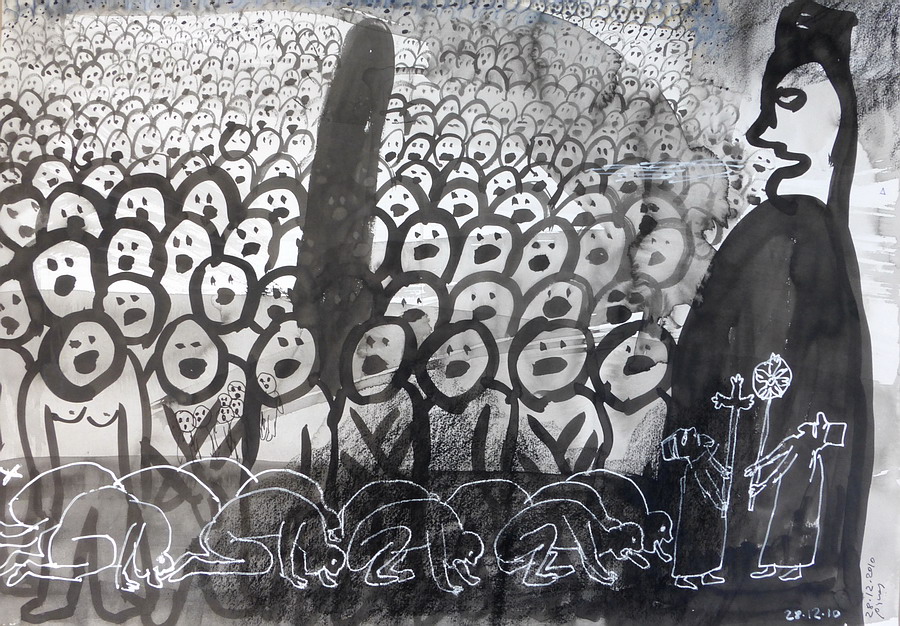
Inge Baecker, owner of the gallery, is a prominent art historian and curator who cooperated with many artists from the historic Fluxus group of the 60’s and 70’s. The gallery started in 1970 in Bochum and later moved to Cologne. Her first show was the work of Wolf Vostell and she has exhibited many internationally known artists such as Allan Kaprow, Michael Klerman, Al Hansen, Geoffrey Hendricks, Nam June Paik, Dick Higgins, Milan Knizak, Phil Corner, Sakir Gökcebag , Endre Tot, John Cage, Ulrike Rosenbach and others. Inge Baecker has curated major exhibitions and cooperated with art movements and artists in Germany and other countries. ( www.galerie-baecker.de ) She is the curator of “On Target”, a project of Pafos 2017 European Capital of Culture which is based on the work “Human Targets” by Rinos Stefani.
Rinos Stefani in Galerei Inge Baecker is showing his work titled “Exographies”. Since 1998 he produced his most prolific body of distinctive painting series, the Erotic, the Acrobats and the Dancers. Dr Antonis Danos writes that “there is a continuous exploration and negotiation of the human condition: of erotic, existential or ecological anxieties. All these are manifested in a mood of ambivalence, comical as much as tragic, with a sense of humour, sympathy or caustic critique, as well as in a prevalent sensuality”. His “Exographies” includes ink drawings as well as large paintings in which the palette has been reduced to almost black and white. While he still uses acrobats, cruciform dancers and other familiar symbols from his previous work such as masks, saws, tree trunks, tables etc, he develops a new iconography and a new approach to drawing. One of the most characteristic new images he often uses is the odd looking crowds, masses of people or anthropoids. This represents a further step in the development of his imagery.
From the 90’s onward Stefani did ‘Praxeis’ in galleries and public spaces. “Praxeis” are installations combined with performative elements. From his first “Praxeis with Earth” in 1991 in Nicosia to the “Charcoal Project” in the Buffer Zone of Pyrgos-Limnitis, Cyprus in 2011, Stefani´s painting, performances and Praxeis have developed in an organic and coherent unity.
SOLDIERS – TARGETS, 1994
The Cyprus weekly, April 22 – 28, 1994, by Glyn Hughes
Kathodos in Akamas: In 1991 a group of Paphian artists started “Kathodos” and presented their work in the Tombs of the Kings. They have been working on another project this spring in the Akamas area called “Ecotopia” and have tried to exploit the possibilities of creating works of art with nature. They started off from the Coast of Achaeans in the Maa area to Ayios Georgios of Peyia on Sunday 24 April, 6 pm
Rinos Stefani organises another “Praxis” as he calls his happenings. Motivated by the warning sign of the Akamas area “Danger, do not touch” and the military targets, he created an army of facsimile Soldiers – Targets and arranged them in line along the coast. This work evokes his “Praxis” when he placed 20 identical mannequins on the beach among the bathers in July 1992.
Susan Vargas is dealing with the “Boat” as an archetypal symbol, charged through the centuries with different symbolisms such as the vehicle which carries the soul to the “other” world, as a symbol of movement which unites different cultures as well as a symbol between the natural and the metaphysical.
EROTIC WORK TEXT BY COSTAS ECONOMOU
Το έργο του Ρήνου Στεφανή δονείται από κίνηση και ενέργεια και χαρακτηρίζεται από αμεσότητα και αυθορμητισμό, παρόλο που είναι προϊόν επίμονης προσπάθειας και περίσκεψης. Ο καλλιτέχνης δεν χάνει επαφή με τη πραγματικότητα, καταπιάνεται με ερευνητική διάθεση με το θέμα του και αποφεύγει την εύκολη ικανοποίηση του θεατή στοχεύοντας να δώσει έργα που να ανταποκρίνονται στις δικές τους αυστηρές προδιαγραφές για το τι μπορεί να θεωρηθεί έργο τέχνης. Το αποτέλεσμα είναι ένα έργο γνήσιο, γεμάτο αλήθεια και ειλικρίνεια.(Κώστας Οικονόμου, Νοέμβρης 1999)
HUMAN TARGETS, 1994
The “Human Targets” installation deals with questions of military conflicts, war and violence. In 1990 Stefani found a perforated military target in the Akamas area, Cyprus. In 1994 he made the installation “Soldiers – Targets” which in the following years was presented in various renditions both in Cyprus and abroad. In May 1994, during the exhibition of the Pan-Hellenic Art Symposium at Famagusta Gate, Nicosia, three of the Soldiers – Targets were stolen. This unprecedented incident fed the media with “polemic” material, and elicited varied reactions from the Police, the Nicosia Municipality, the Chamber of Fine Arts and the Ministry of Education and Culture. Among the most tragicomic aspects of this case were the various testimonies that the artist had to give to the Police. In 11.7.1994 the police found one of the targets. Since then, the “Targets case” remains partly unsolved in the files of the Criminal Investigation Department, under record number Σ/744/94.
In 2000 Stefani showed the installation “Human Targets”, a direct continuation of his “Soldier – Targets” at the show “From the Chisel to the Electron – A century of Contemporary Sculpture in Cyprus” at the National Gallery of Cypriot Art & Casteliotissa, Nicosia, Cyprus. In 2005 the “Human Targets” were showed at the Nicosia Municipal Arts Centre for the exhibition “Accidental Meetings”
In 2011 Stefani proposed a project titled “On Target” for the candidacy of Paphos for the European Capital of Culture 2017. In 2013 Paphos won the title and On Target was included in the official program of Pafos 2017.
CORAL BAY TARGETS, 1995
Rinos Stefani’s installations SOLDIERS – TARGETS and HUMAN TARGETS deal with questions of military conflicts, war and violence. In 1990 Stefani found a perforated military target in the Akamas area, Cyprus. In 1994 he made the installation “Soldiers – Targets” which in the following years was presented in various renditions both in Cyprus and abroad. The Coral Bay Targets is a praxis which Rinos Stefani did at Coral Bay, Paphos in 17 August 1995 during the peak of the touristic season in Cyprus. The artist placed his Soldiers – Targets installation along the beach, among the bikini clad crowd. In 2000 Stefani simplified the form of this installation by modifying Soldiers – Targets, changing their size and colour. They became Human Targets. In 2011 Stefani proposed a project titled “On Target” for the candidacy of Pafos 2017 European Capital of Culture. In 2013 Pafos won the title and On Target project was included in the official program of Pafos 2017.
RE – AL DANCERS, 2013 – 2015
Rinos Stefani’s series of Praxeis and installations titled SOLDIERS – TARGETS and HUMAN TARGETS as well as his paintings on the theme of cross-shaped syrtaki DANCERS are the progenitors of his latest RE – AL creations, which turn the green military canvas into a literal battle field, perforated with holes inflicted by a red-hot metal, substitute to a machine gun. The traumatic shots penetrate the material substance of the work itself and the physical and esoteric substance of the white crucified figure, delineated with a bold, gestural expressionism. Hovering between a harsh political and economic reality on the one hand and a utopia on the other, between dignity and humiliation, life and death, the haloed figure, flanked by crosses made of cloth stitches and surrounded by pain and agony schematically cast on the heads of an anonymous populace below, passes from the earthly to the celestial: “And about the ninth hour Jesus cried with a loud voice, saying, Eli, Eli, lama savachthani? “
Dr. Nadia Anaxagorou, Exhibition “RECTO – VERSO: From Byzantium to Modernism”, Evagoras Lanitis Centre, Limassol, 20 March – 8 May 2015.
THE CREATIVE PROCESS OF RINOS STEFANI, 2010
The creative process of Rinos Stefani, far from any academic education and his academic standards, is based on a spontaneous variation of motifs, which spring freely from one painting to the other, as interconnected series, taking eventually a form which is «imposed», one that has not been consciously selected, and one that is transformed and enriched semantically. That is why the artist gives titles to his works after he has finished painting and these have a very loose connection to the actual content. For example, the title of his painting According to the Low of the People‘s Republic of China, which he executed based on the memories of a trip to Beijing, is not directly related to a particular real experience or with the painting itself.
This is also the case with the painting Messenger of Alcala street. The artist establishes a game, at times a sarcastic one, but always charming, between that which is depicted in his work and the title, shifting the viewer’s thought to other conceptual areas, as surrealists did with poetry. The more the title moves away from the actual content of his work, the more likely it is for the poetic miracle to occur.
Rinos Stefani likes the new realities that come about from the connection of two totally different fields. It is the same mechanism that connects, consciously or subconsciously, experiences and memories from those trips that influence him. In the former of the two paintings mentioned above, faces, objects, letters and signs coexist in an unrelated way. What connects them is the single painting surface, which serves a semantic role without, however, defining a specific place.
The key element that dominates in the image is the mingled figures in blatantly exploding erotic positions, which seem to be over the moon at the peak of erotic frenzy. It is “an invariably direct, ‘natural’ sexuality, primitive […] eroticism.” Indeed, in his erotic works, there is an unrestrained sexual sensuality, together with a savagery that accompanies it outside social conventionalities. The artist’s attraction to primitive peoples is not accidental, just as it was not accidental for Antonin Artaud, who, with the Theatre of Cruelty, wanted to give the power of primitive savagery to the human body.
The love couples of Rinos, as if they are “unchanged images of a primordial ritual” walk on a tightrope and float – both an image and a symbol of the boldness of the artist, who plays with fire. Images boxed in multiple combinations form a continuous process of deconstruction and construction until the final theme of his work is established. At the bottom of the painting we see three figures, three walkers with disproportionate bodies who move around wearing gas masks.
These masks, which can also be seen in the artist’s other two paintings, a symbol of protection from an imminent threat, semantically define, according to Stefani, our age since these naked bodies are timeless and are ideally connected with the primitive. Metaphysical concerns, real fears for existing dangers and social criticism are some of the issues that are crystallized in these masks, a motif that recurs in many paintings of the latest series executed by the artist. Together with the human figures, there are words as a direct reference to graffiti, as visual signs which exert a special appeal, irrespective of their semantic content. This is also the case with the timeless symbol of the Cross, which transcends any allusion to religion and often recurs in order to balance the composition; this element applies also to the arrow in his work Messenger of Alcala street.
Another enigmatic element in these in these two paintings is the motif of the parallel abstract lines: they look like prison bars or steps leading nowhere; yet they are just three trunks; timber piles that impressed the artist when he saw them on a trip to the Amazon Basin; images, which he associates with the memories of the wood piles he saw as a child in his village. Very often than not, in Rinos Stefani’s work there is a merge of elements that characterise different places and time periods, transcending a specific reality. The condensation of allusions, elements and motifs annuls the first obvious perception one has of his works, emphasizing the polysemy of artistic reality. In Amacayacu, the same faceless people, always wearing gas masks, move around in an unreal world, holding these odd objects under their arms – we are not sure whether they are huge phalluses, which form a cross, an aeroplane, a weapon or even amputated torsos of imaginary beings. Tree trunks, which in other paintings are depicted in piles, acquire here an erotic, threatening and violent content, in which there is even a reference to environmental problems. Like a modern trapeze artist, Rinos Stefani each time takes the risk of falling from the tightrope and it is this real risk that gives to his paintings not just the character of representation but the actual “Praxeis” * itself.
*Basically, there is no difference between the various happenings, which the artist calls PRAXEIS, since there is continuity throughout his creative process that each time is expressed in a different way, using a different medium.
Dr Andri Michael, Art Historian, Faculty of Art [UPJV], Amiens, France, Exhibition “The Body: Stories and Representations”, Evagoras Lanitis Centre, Limassol. 16 June – 31 July 2010
THE JOURNEYS OF RINOS STEFANI. 2008
Journeys and travel have always inspired artists. Art also changes the way we view and perceive places. Journeys are really about having a certain mindset which considers the destination to be just as important as what one absorbs on the way. And one must not forget that journeying new places implies merging the unknown and its challenges. This is what has occurred with Rinos Stefani’s art, which has been inspired and infused by different continents and specific places he has journeyed to.
In London, where he studied, he unwrapped the intricacies of galleries, museums, the Old Masters, as well as modernist and contemporary art. While there, he also discovered the multicultural society, observing its depths and its shallowness, and absorbing how other people lived – their music, history, food. From London, he traveled to other European cities. Every new experience opened up a new surface and depth, accepting and valuing diversity, subtle differences and the unknown.
In Berlin, he was surprised by encountering the music of the Andes by the Latinos. This later took him to the other side of the Atlantic, to South America: from cosmopolitan Bogotá to Medellin, from San Agustin in the Andes to Cartagena and Santa Marta in the Caribbean. From there, he journeyed south to the Amazon River, where Colombia meets Peru and Brazil, catching piranhas while watching trunks float down the river. An adventure and a challenge by the nameless.
Spain and France also left an imprint – Catalonia and its Romanesque art, the Pyrenees, the Basque countryside, the Paleolithic paintings in the caves of Isturitz and Oxocelaya in Baja Navarra between Lascaux and Altamira, all have imbued his work. Then, Stefani arrived in China. He walked on the Great Wall and the Yellow Mountains in Hefei, which made a dent on him.
His eagerness to venture into new places took him also to the United States: firstly, to Florida, with its influx of Caribbean and South American influences, diversity and fast-paced life and food. He then encountered the Everglades where crocodiles abound, while a fierce storm almost left him stranded and lost and experiencing profound fear. He traveled through cities and towns making friends with the down to earth people. He arrived in Ohio, where he was amazed that communities like the Amish can live within a consumer society without electricity, cars or television. He saw glaciers from thousands of years ago, on an island in Lake Erie, with Canada only nine miles away. A professor took him on a walk through an old cemetery for the mentally ill, where patients years ago were buried with only a number.
This leads us back to his home country, Cyprus. Ancient settlements – some nine thousand years old –, the Troodos Mountain, Byzantine churches with outstanding mural paintings, wines, olives, carob trees… Even here, Stefani continues to journey outside and inside his mind, always making certain that his art constantly renews itself.
Caroline Frances Vargas
Free-lance writer, 2008, Ohio USA
ARTIST’S NOTE, 2008
The creation of the Lovers, the Acrobats and the Dancers began in 1998-99. First came the Lovers. By the end of 1999, the figures in these “erotic” works looked like acrobats. During that period, I was teaching in a school in Pafos, the Art room of which was a humid space, far away from the main building and the main entrance to the school. To get into the school, I preferred to jump over the fence on Venizelou Street. I created in my mind a setting with an acrobat as the protagonist, which I connected to my own jump over the fence, and I began to elaborate on the concept of the acrobat: what does it mean? Does it imply the challenge of danger, of the grave risk of falling off the tight rope? Is it an allegory of the artist’s desire to escape from a conservative and aesthetically miserable environment? Or is it, after all, symbolic of his effort to balance opposite factors, in order to secure his physical and spiritual survival?
Parallel to the above process, drawings and paintings were produced – not necessarily in this order and with such ease. Before a painting is finished, it often undergoes countless changes. I also make preliminary studies, in order to get a better grasp of the subject and to find solutions to aesthetic problems. I consider many of these sketches to possess “autonomy” in their own right. The first drawings of “acrobats” were created on February 3, 1999. Since then, I have made hundreds more (mostly in ink): lovers, acrobats, dancers, travelers.
My work – the paintings, as well as the Praxeis (“actions” and installations) – in which the human figure is the central element, derives, I think, from the same internal need. The artist cannot change society on his own, even if he is into political activism. The best thing he can do is to create his work, and to be aware of his limits. But which limits? After all, the artist is constantly obliged to question the established limits. He is obliged to take risks and to embrace the tension of a fragile balance, in order to safeguard his dignity and freedom.
Rinos Stefani, April 2008